In mid-century America, Catholic schools stood as a cornerstone of education for millions of families seeking structured learning infused with faith. While today’s classrooms are equipped with interactive whiteboards, tablets, and flexible schedules, the typical day of a Catholic school student in the 1950s followed a very different rhythm—one that was consistent, disciplined, and rooted in community and tradition.
This blog takes a step back in time to explore what a typical school day looked like for a Catholic school student in the 1950s—from the moment the school bell rang to the final prayer of the afternoon.
The Morning Routine: Uniforms and Reverence
The day began well before the first bell. Students dressed in neatly pressed uniforms—navy jumpers or skirts for girls, slacks and white shirts for boys—often with matching ties, knee socks, or polished shoes. These uniforms were not just about appearance; they were an early lesson in discipline, modesty, and conformity.
Upon arriving at school, children would gather in designated areas by grade level, standing in quiet lines. There was little room for running around or excessive chatter. Once inside, students placed their coats and belongings in tidy rows or inside wooden cubbies. Before any academic instruction began, the day was often rooted in spirituality, with a prayer, the Pledge of Allegiance, and sometimes a short reading from the Bible or catechism.
Mass and Religious Instruction
In many Catholic schools during the 1950s, attending daily or weekly Mass was an integral part of the curriculum. Students filed into church—boys on one side, girls on the other—and participated in Latin liturgies with a level of reverence and routine that defined the school culture.
Mass served as more than a religious obligation. It reinforced values like humility, patience, and community. For students, serving as altar boys or singing in the choir became rites of passage and markers of spiritual growth.
Back in the classroom, religious education was as central as math or reading. Catechism lessons—often memorized and recited aloud—taught the fundamentals of Catholic doctrine. Students learned prayers, commandments, and moral teachings from nuns or lay teachers with deep devotion to their vocation. Faith was not an elective; it was a daily presence.
Academics and Expectations
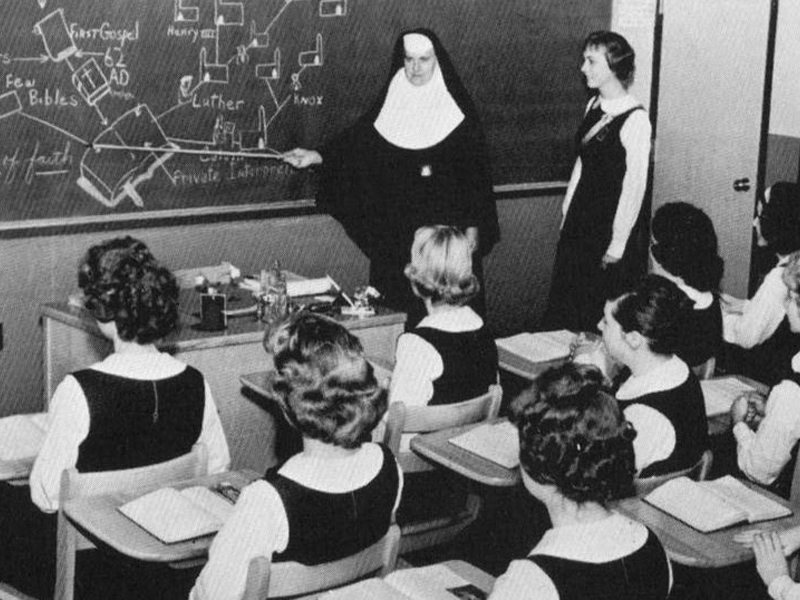
Catholic school classrooms in the 1950s were typically arranged in straight rows of wooden desks, each bolted to the floor, with a large chalkboard at the front and framed portraits of Jesus, Mary, or the Pope hanging above. Class sizes often exceeded 40 or even 50 students, but discipline and focus were the norm.
Instruction was straightforward, repetition-based, and often memorization-heavy. Subjects included arithmetic, penmanship, reading, grammar, geography, and spelling. Textbooks were clean and simple, and students were expected to keep their notebooks neat and orderly.
Teachers, many of whom were Catholic sisters in full habit, maintained strict standards for behavior. Speaking without permission, chewing gum, or failing to complete homework could result in a firm reprimand—or occasionally, a physical punishment that was socially acceptable at the time. Yet many students recall these educators with admiration and respect. The expectations were high, but so was the commitment to student success.
Lunch, Recess, and Routine
Most Catholic schools in the 1950s did not have cafeterias. Students brought lunch from home in metal boxes—usually sandwiches, fruit, and a thermos of milk or soup. Some ate in classrooms, others in multipurpose rooms or basements converted into temporary dining spaces. Lunch began and ended with a prayer.
Recess was often short but structured. Children played games like hopscotch, jump rope, or dodgeball in schoolyards, under the watchful eye of supervising teachers. Outdoor space was usually limited, particularly in urban areas, but the break from rigid classroom rules offered a brief chance to be loud and active.
Afternoon Lessons and Final Prayer
The second half of the school day mirrored the first in structure and discipline. Subjects like science, civics, or music were common in the afternoon, along with more religious instruction. Students practiced penmanship, took spelling tests, or participated in call-and-response grammar drills.
Art and music, while less emphasized than core academics, still had a presence. Students might sing hymns, learn patriotic songs, or draw biblical scenes using crayons and construction paper.
As the school day came to a close, students recited a final prayer, cleaned their desks, and prepared to return home. Homework was assigned regularly and expected to be completed neatly and on time.
Values Beyond the Curriculum
More than anything, Catholic school in the 1950s was about shaping character. Students learned to show respect to teachers, elders, and authority figures. They were taught to be punctual, honest, and responsible. Confession and communion were regular rituals that reinforced the importance of accountability and forgiveness.
Even with its rigidity, many graduates of 1950s Catholic schools credit that foundation with giving them a moral compass and a strong work ethic. The school day extended beyond academics, forming habits and values that carried into adulthood.
A Legacy That Endures
While Catholic education has evolved significantly since the 1950s—with updated teaching methods, co-ed policies, and inclusive curricula—the essence of its mission remains the same: to educate the mind while nurturing the soul.
The era of chalkboards and Mass may seem distant now, but its impact lingers in the lives of those who lived it, where discipline, faith, and education walked hand in hand every single day.